Table of Contents
- What Makes a Martial Art Effective for Self Defense?
- Jujitsu: Ground Fighting and Control
- Kickboxing and Boxing: Striking, Footwork, and Range Management
- Wrestling and Judo: Takedowns, Throws, and Balance
- Krav Maga and MMA: Real-World Application and Comprehensive Systems
- Martial Arts for Beginners: How to Start Training Safely
- How to Choose a Self Defense Class That Fits Your Goals
- Martial Arts Training Duration: How Long Until You Can Defend Yourself?
- Frequently Asked Questions
Last Updated: September 17, 2026
What Makes a Martial Art Effective for Self Defense?
The best martial arts for self defense are the ones you can actually use under stress: they train live resistance, cover multiple ranges, and fit your body, age, and schedule. Style matters less than how it is taught.
That distinction is where most rankings go wrong. A list of “deadliest arts” tells you nothing about whether you will still be training in six months, or whether your instructor has ever pressure-tested what they teach. At Alexander’s Martial Arts, we have watched this play out for over three decades in the Huntsville and Madison area: the students who stay safe are the ones who train consistently in systems built around realistic scenarios, not trophies.
Effectiveness comes down to four things:
- Live pressure testing against a resisting partner, not choreographed drills alone
- Range coverage from striking to clinch to ground fighting
- Situational awareness and de-escalation taught alongside physical technique
- Sustainability for your age, fitness level, and weekly schedule
Federal Bureau of Justice Statistics data on violent victimization shows that most assaults happen at close range, often involving grabs or takedowns. That single fact reshapes the question. You are not choosing a sport. You are choosing a training method for the worst ten seconds of your life.
Jujitsu: Ground Fighting and Control
Jujitsu is the strongest ground-fighting system for self defense because it teaches a smaller person to control a larger attacker through use, positional control, joint locks, and chokes.
The core insight of Jujitsu is that most fights end up close, and the ground is where untrained people panic. Jujitsu students drill escapes from mount, guard, and side control until those movements become automatic. Sparring, called rolling, is live and continuous, which is the closest thing martial arts training offers to real resistance.
Where it falls short: sport BJJ has drifted toward techniques that assume a referee and a mat. Pulling guard makes no sense on concrete. If you train Jujitsu for self defense, look for a school that teaches standing self-defense scenarios alongside sport technique.
Kickboxing and Boxing: Striking, Footwork, and Range Management
Kickboxing and boxing are the best striking systems for self defense because they build hand speed, footwork, and range management under full-contact pressure.
Boxing teaches the jab, the most useful single technique in a self-defense scenario, plus head movement and the ability to create distance. Kickboxing adds elbows, knees, and the clinch, which matters because most real confrontations close the gap quickly.
|
System |
Primary Strength |
Range Trained |
Live Sparring |
|---|---|---|---|
|
Boxing |
Hand speed, footwork |
Long to mid |
Yes, full contact |
|
Muay Thai/Kickboxing |
Clinch, knees, elbows |
Long to close |
Yes, full contact |
|
BJJ |
Ground control |
Close to ground |
Yes, grappling |
|
Wrestling |
Takedowns, control |
Mid to close |
Yes, live |
|
Judo |
Throws, balance |
Close |
Yes, live |
|
Krav Maga |
Scenario defense |
All ranges |
Varies by school |
|
MMA |
Complete system |
All ranges |
Yes, full contact |
The honest limitation: striking arts assume you can absorb or avoid hits. If you are smaller or untrained, a single clean punch can end the encounter. That is why counter-striking and defensive tactics belong in the same curriculum as offense.
Wrestling and Judo: Takedowns, Throws, and Balance
Wrestling and Judo are the best systems for controlling where a fight happens, because both specialize in takedowns, throws, and balance disruption.
Wrestling builds the physical conditioning and spatial awareness that make everything else easier. A wrestler decides whether the fight stays standing or goes to the ground. Judo converts an attacker’s momentum into a throw, which is devastating on hard surfaces and often ends a confrontation instantly.
The catch is the learning curve. Both arts punish beginners with hard falls, and both require a training partner willing to be thrown repeatedly. Joint locks and chokes appear in Judo’s groundwork, but the stand-up game is where it earns its reputation.
For adults returning to fitness, these are demanding starting points. For teenagers, they build discipline and confidence faster than almost anything else.
Krav Maga and MMA: Real-World Application and Comprehensive Systems
Krav Maga and MMA sit at opposite ends of the self-defense spectrum, and both belong in this conversation for different reasons.
Krav Maga is built entirely around real-world application: weapon defenses, multiple attackers, and escape-first principles. Its weakness is quality control. Because there is little competition structure, standards vary wildly between schools, and some programs teach techniques that have never been tested under pressure.
MMA is the most complete combat system available, combining striking, clinch, takedowns, and ground fighting. Fighters train under full-contact conditions, which builds genuine combat effectiveness and the psychological stress response needed when adrenaline dumps. The trade-off is that MMA is a sport with rules.
EXPLORE OUR MARTIAL ARTS PROGRAMS →
Martial Arts for Beginners: How to Start Training Safely
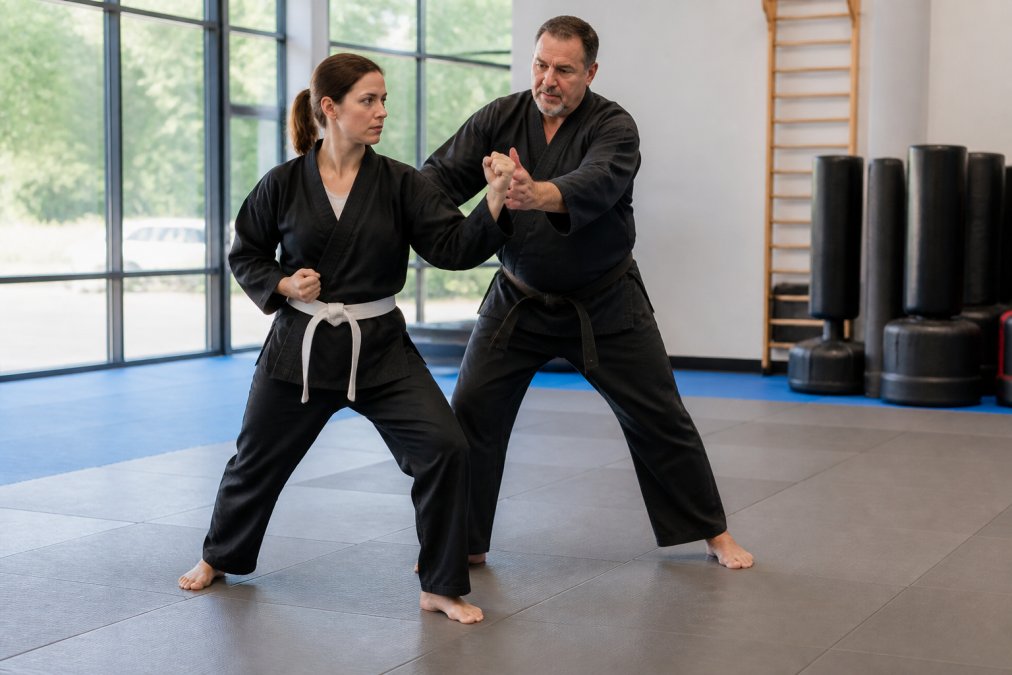
Beginners should start with a school that teaches fundamentals, prioritizes safety, and lets you observe a class before committing. The style matters less than the environment, and the environment has to fit your body, your age, and your current fitness level, not a hypothetical 22-year-old athlete.
If you are 40+ or returning to fitness:
- Prioritize arts with lower impact on joints. Boxing and Muay Thai bag work are easier on knees than Judo or Wrestling throws, which require repeated falls on a hard mat.
- BJJ is often the most sustainable grappling option for older adults because much of the training happens on the ground with controlled pressure rather than high-amplitude throws.
- Ask about warm-up structure. A 15-minute dynamic warm-up before drilling is a green flag; jumping straight into hard sparring is a red flag.
- Expect a 4-8 week adaptation period where soreness is normal but sharp joint pain is not. Sharp pain means stop and reassess.
If you have limited mobility or a prior injury:
- Seated and standing self-defense drills exist in most Krav Maga and boxing programs. Ask specifically whether the school can modify drills.
- Avoid any program that treats modification as weakness. Good instructors adapt; bad ones shame.
If you are a teenager or child:
- Ages 4-12 develop gross motor skills and focus through structured, playful instruction. Look for programs with clear age bands rather than mixed-age classes.
- Teens benefit most from anti-bullying strategy plus basic striking and escape fundamentals. Pure sport competition tracks are a different goal.
- Warm-ups that match your fitness level. You should be tired, not injured.
- Controlled sparring. Beginners should not be thrown into full-contact sparring in week one. Ask what the progression looks like, usually 3-6 months of drilling before live rounds.
- Clear progression. Belt systems, even informal ones, signal that the school has a curriculum rather than random drills.
- Instructor attention. If a class has more than 20 students and one instructor, ask how they handle beginners.
How to Choose a Self Defense Class That Fits Your Goals
- Does the school teach de-escalation and verbal boundary setting, not just physical techniques?
- Do instructors hold verifiable certifications or competition records?
- Can you watch a full class before signing anything?
- Is there a clear path from beginner to intermediate?
- Do current students look like you in age and fitness level?
- Are there hidden fees for belt testing or gear?
- Does the curriculum include situational awareness drills, recognizing pre-attack indicators, managing distance, and exiting a confrontation before it escalates?
If you are in the Huntsville or Madison area, Alexander’s Martial Arts offers both in-person classes and a live online university, so families can train together or from home when schedules get tight. Our curriculum covers common sense, verbal, and physical self-defense, not just striking drills.
Martial Arts Training Duration: How Long Until You Can Defend Yourself?
Most students develop usable basic self-defense skills within three to six months of consistent training, and meaningful competence after one to two years. There is no shortcut.
|
Training Stage |
Typical Timeline |
What You Can Do |
|---|---|---|
|
Fundamentals |
1-3 months |
Basic stance, distance, simple escapes |
|
Functional basics |
3-6 months |
Defend common grabs, create distance, stay calm |
|
Competence |
1-2 years |
Handle most untrained attackers, spar confidently |
|
Advanced |
3+ years |
Full range control, teachable technique |
Frequently Asked Questions
What martial art has the best defense for real-world situations?
No single style covers every scenario. Brazilian Jujitsu handles ground fighting, Muay Thai / Kickboxing and boxing cover striking and footwork, and wrestling or judo manage takedowns. Krav Maga and MMA combine these ranges. The best defense comes from training multiple ranges with live pressure testing, not from one art alone.
How do I choose the right martial arts school for my family?
Visit the school in person and watch a class. Check instructor credentials, student-to-teacher ratios, and whether the curriculum includes de-escalation and situational awareness. Ask about trial classes and belt testing costs. A quality school will let you observe and ask questions before you commit.
How long does it take to learn effective self-defense skills?
Basic defensive skills can be learned in a few months of consistent training, but real proficiency takes one to two years. The key is regular practice with live pressure testing. Martial arts training duration depends on how often you train and whether you spar. Even six months of weekly classes builds meaningful awareness and physical responses.
Are traditional martial arts effective for self-defense?
Some traditional arts include practical self-defense, but effectiveness depends on how they are taught. Styles that include sparring, live pressure testing, and realistic scenarios tend to transfer better to real confrontations. Traditional forms without resistive practice may build discipline and fitness but leave gaps in practical application.
